
The Pitch That Raises Eyebrows
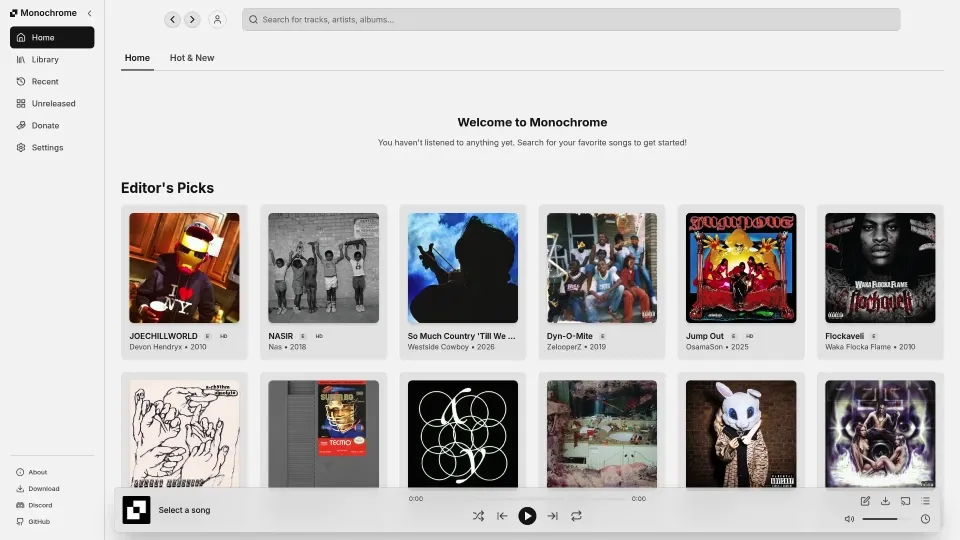
Imagine a music streaming service that offers hi-res lossless audio, has no advertisements, requires no subscription fee, respects your privacy, and is completely open-source. It sounds like a dream-or perhaps a red flag. That is precisely what Monochrome promises, and it is raising questions across online communities about whether something this good can possibly be legitimate. The service, accessible at monochrome.tf, presents itself as a minimalist alternative to mainstream platforms, offering access to millions of tracks through a sleek interface that feels like a premium product. Yet the very features that make it attractive-free access to high-quality music without ads-are the same ones that have observers drawing parallels to services that met dramatic ends.
Monochrome describes itself as "an open-source, privacy-respecting, ad-free TIDAL web UI" built on top of an API project called Hi-Fi. In practical terms, this means it functions as an alternative interface for accessing TIDAL's extensive music catalog without requiring a TIDAL subscription. Users can search for artists, create playlists, stream high-fidelity audio, and even download tracks for offline listening-all without paying a cent or creating an account. The project is fully open-source on GitHub, where it has garnered significant attention from developers and music enthusiasts alike.
How Monochrome Actually Works
Understanding Monochrome requires peeling back a few technical layers. The service does not host any music itself. Instead, it functions as a sophisticated intermediary, using the Hi-Fi API to communicate with TIDAL's servers. When a user searches for a song on Monochrome, the request is routed through this API, which retrieves the audio streams directly from TIDAL's infrastructure. The audio plays in the user's browser, and Monochrome's interface provides a cleaner, ad-free experience compared to TIDAL's official applications.
The feature set is genuinely impressive for a free service. Users can stream in Hi-Res FLAC quality, access synchronized lyrics with karaoke mode, import playlists from other platforms like Spotify and YouTube Music, sync their libraries across devices with optional accounts, and even integrate with Last.fm for scrobbling. The interface supports keyboard shortcuts, includes a command palette for power users, and works as a Progressive Web App (PWA) for offline functionality. It is, by all technical measures, a polished piece of software.
The Spotify Comparison: What You Gain and Lose
When placed side by side with Spotify, the industry's dominant streaming platform, the contrast is stark-and Monochrome comes out ahead in several categories. Spotify's free tier is notoriously limited: ads interrupt listening, audio quality is capped at 128kbps on mobile, and features like on-demand playback are restricted. Even Spotify Premium subscribers, who pay $12.99 monthly, max out at 320kbps audio quality. Monochrome, by comparison, offers Hi-Res FLAC streaming at no cost, representing a significant leap in audio fidelity for audiophiles who prioritize sound quality above all else.
The privacy angle is another point of divergence. Spotify collects extensive user data-listening habits, playlist interactions, search history, and even location data in some contexts-to fuel its recommendation algorithms and advertising business. Monochrome, being privacy-respecting by design, does not track users in the same way. There are no targeted ads because there are no ads at all. For users increasingly concerned about data collection, this represents a meaningful philosophical difference.
However, Spotify offers advantages that Monochrome cannot match. Spotify's recommendation engine, powered by years of data and sophisticated algorithms, is genuinely useful for music discovery. Its massive user base enables social features like collaborative playlists and friend activity feeds. The platform has official apps for every device imaginable, smart speaker integrations, and the reliability that comes with being a multi-billion dollar corporation. Monochrome, operating as an unofficial interface, cannot offer the same ecosystem integration or guarantee the same level of service reliability. Perhaps most significantly, Spotify pays royalties to rights holders-a point that brings us to the elephant in the room.
The Grooveshark Parallel: A Cautionary Tale
For those who have followed the streaming industry long enough, Monochrome's model evokes uncomfortable memories of Grooveshark. Launched in 2006, Grooveshark was once one of the most popular music streaming services on the internet, offering free access to a vast library of songs. Like Monochrome, it was innovative, user-friendly, and completely free. Also like Monochrome, it operated in a legal gray area that would ultimately prove unsustainable.
Grooveshark's model was based on user uploads: users would upload their music collections, and those files would become available to all other users. The company argued it was protected by the Digital Millennium Copyright Act (DMCA) safe harbor provisions, claiming it removed copyrighted content when notified. However, the major record labels disagreed and filed a series of lawsuits that would span nearly a decade.
In 2014, a federal judge ruled that Grooveshark's copyright violations were "willful," finding that company employees had personally uploaded thousands of copyrighted songs. The writing was on the wall. In May 2015, facing a potential $736 million judgment and a $17 billion lawsuit organized by major labels, Grooveshark shut down. The company issued a public apology, agreed to wipe all user data, and ceased operations entirely. The service that once served millions of users was gone overnight.
The parallels to Monochrome are not exact, but they are significant. Both services offer something that seems too good to be true: free access to copyrighted music. Both operate without licensing agreements from major labels. And both have attracted devoted user bases drawn to the combination of quality, convenience, and cost-or lack thereof. The key difference lies in the technical implementation: Grooveshark hosted and distributed actual music files, while Monochrome acts as an interface to an existing licensed service (TIDAL). Whether this technical distinction provides meaningful legal protection remains an open question.
The Question of Longevity
For users considering Monochrome, a practical question emerges: how long will this last? The service's GitHub repository shows active development, with recent commits and a growing community of contributors. The project has gained visibility, being featured on forums and tech communities. But this visibility cuts both ways. Services that operate in legally ambiguous territory tend to face increasing scrutiny as they grow, and Monochrome's growing user base may eventually attract the attention of rights holders who have historically been aggressive in protecting their catalogs.
There is also the question of the underlying API's stability. Monochrome depends entirely on the Hi-Fi API's ability to communicate with TIDAL's servers. If TIDAL implements changes to its authentication or streaming protocols-an entirely plausible scenario-the service could break overnight. Unlike licensed services that have contracts guaranteeing access, Monochrome exists at the pleasure of technical workarounds that could be disrupted at any time.
What Users Should Know
Monochrome represents a fascinating case study in the ongoing tension between consumer demand for accessible music and the industry's business models. The service is technically impressive, genuinely useful, and offers features that would cost money elsewhere. It is also, by its own admission, an unofficial interface operating without licensing agreements-a status that carries inherent uncertainty.
Users should approach Monochrome with clear eyes. The service works, and works well, but there is no guarantee it will continue to work. Playlists and libraries could disappear. Accounts could be lost. The service itself could vanish, as Grooveshark did, leaving users to rebuild their collections elsewhere. For some, the trade-off is worth it: immediate access to high-quality music at no cost. For others, the uncertainty outweighs the benefits.
Whether Monochrome is "too good to be true" depends largely on one's perspective. It delivers on its promises of free, high-quality, ad-free streaming. But the broader question-whether that delivery is sustainable-remains unanswered. The service's existence highlights a gap in the market that mainstream platforms have not filled, while simultaneously illustrating why that gap persists. For now, Monochrome stands as a compelling, if precarious, option for those willing to embrace uncertainty in exchange for a premium experience at no cost.